Fall 2026
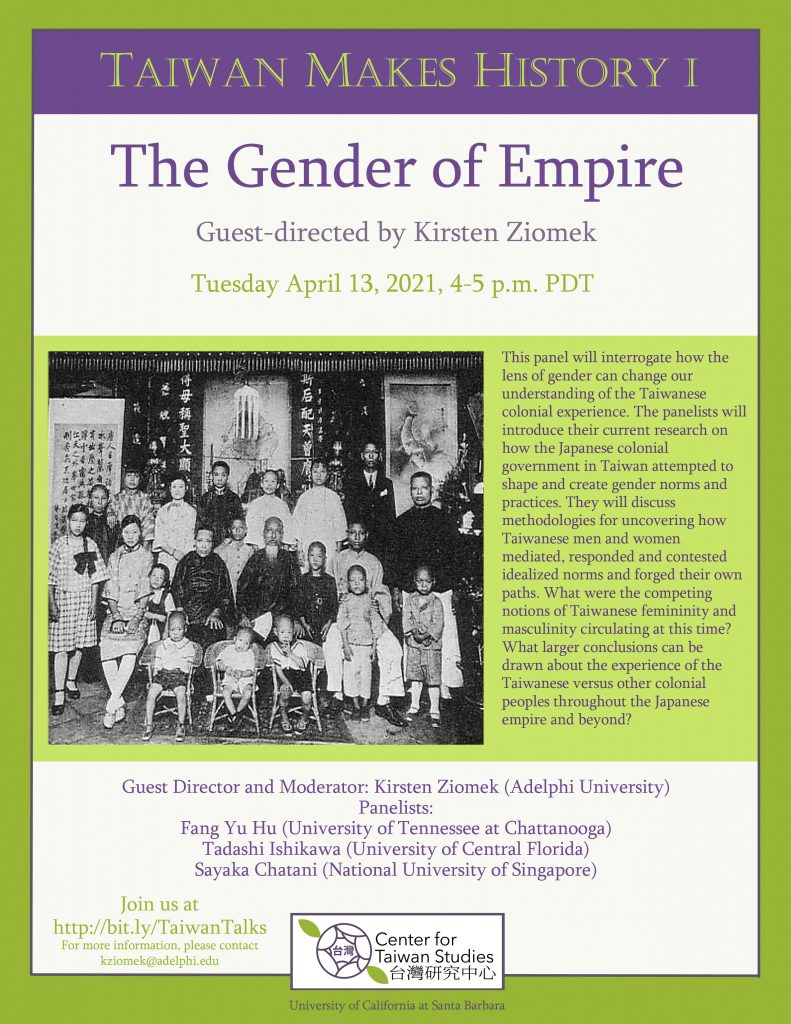
Fang Yu Hu – “Good Wife, Wise Mother”: Assimilating Han Taiwanese Girls Under Japanese Rule (11/16)
Abstract: In Good Wife, Wise Mother: Educating Han Taiwanese Girls under Japanese Rule, I examine the creation, implementation, and impact of Japanese colonial education in Taiwan. My book looks at the perspectives of Japanese colonial officials and some Taiwanese on girls’ education. My book emphasizes that gender remained the most powerful and persistent defining marker of colonial hierarchy, even though Japanese colonial officials used race and ethnicity as the main markers of political and socioeconomic hierarchy, similar to what Euro-American powers had done at the time. Despite institutionalized discrimination, many Taiwanese embraced education, including that of girls, because they believed in the changes that educated girls and women symbolized and could bring to Taiwan in a period dominated by great powers.

Huei-chu Chu – Who Is Reconciling with Whom?—A Taiwanese Perspective on the Issue of the Japanese Military “Comfort Women” (11/2)
Abstract: This talk first teases out debated issues surrounding the Japanese military “comfort women” system, tracing the hierarchical structure of complicity among Japanese bureaucrats, military and police personnel, local brokers, and patriarchal society under the Japanese Empire. It examines how militarized forms of gender and class exploitation were legitimized as gendered imperial military mobilization and sexual labor under wartime capitalism.
The talk then examines two documentary films, Grandma’s Secret and Song of the Reed, focusing on the relatively neglected group of Taiwanese “comfort women” within the broader historical context of demands for accountability, apologies, and reconciliation. By doing so, it explores how the politics of witnessing complicates conventional frame of war for defining perpetrators and victims of the system. Furthermore, it reveals how war accountability framed exclusively through the lens of the nation-state obscures transnational forms of gender and class oppression, as well as the complicity of local societies.

Chia-li Kao – The Invention of Taiwanese Natural Aesthetics in Japanese Tanka Poetry (10/19)
Abstract: During the Japanese colonial period, Japanese settlers in Taiwan confronted a drastically different natural environment. The tanka (waka) tradition, which had long been rooted in the characteristics of four distinct seasons, suddenly lost its anchor within Taiwan’s tropical and subtropical climates. Concurrently, a wave of tanka poetry reform driven by Westernization currents was rising in metropolitan Japan. Caught in the dual tensions between tradition and modernity, as well as the metropole and the colony, Japanese residents in Taiwan progressively attempted to construct a tanka aesthetics capable of responding to Taiwan’s natural environments. This lecture explores this dynamic process.
Chia-li Kao is an associate professor of the Graduate Institute of Taiwan Literature and Transnational Cultural Studies at National Chung Hsing University, Taiwan. She currently serves as Chair of the Graduate Institute of Taiwan Literature and Transnational Cultural Studies and Chair of Bachelor Program in Taiwan Humanities and Creativity.
Kao received a Ph. D. in Comparative Literature from Indiana University at Bloomington. Her research areas include comparative literature, pre-WWII Japanese and Taiwanese literature, and Globalization studies. Her recent research focuses on nature writing in Taiwanese literature under the Japanese rule. She published her book entitled Writing Tropical Islands: Empires, Travel and Imagination (2016) and coedited a book, Crossing Southeast Asia (2021).

Lillian Tsay – In Search of Subjectivity: Researching Taiwan in Japan Studies (10/14)
Abstract: In recent years, Taiwan has attracted growing scholarly attention, driven in part by the rise of its semiconductor industry and by increasing geopolitical tensions surrounding the island. Yet within East Asian Studies, Taiwan has often been approached primarily through the frameworks of Chinese Studies and, more recently, Japanese Studies. This presentation examines the current historiography of Japanese colonial Taiwan, including the presenter’s current and future research, and considers how scholars might preserve Taiwan’s subjectivity within studies of the Japanese Empire and beyond.
Lillian Tsay is an assistant professor of Japanese History at the Université de Montréal. She is currently working on a book manuscript tentatively titled Sugarcoating Empire that examines sugar and confectionery’s role in the Japanese Empire. Her research interests are histories of empire, business and economic history, material culture, and historical memory.

Past events


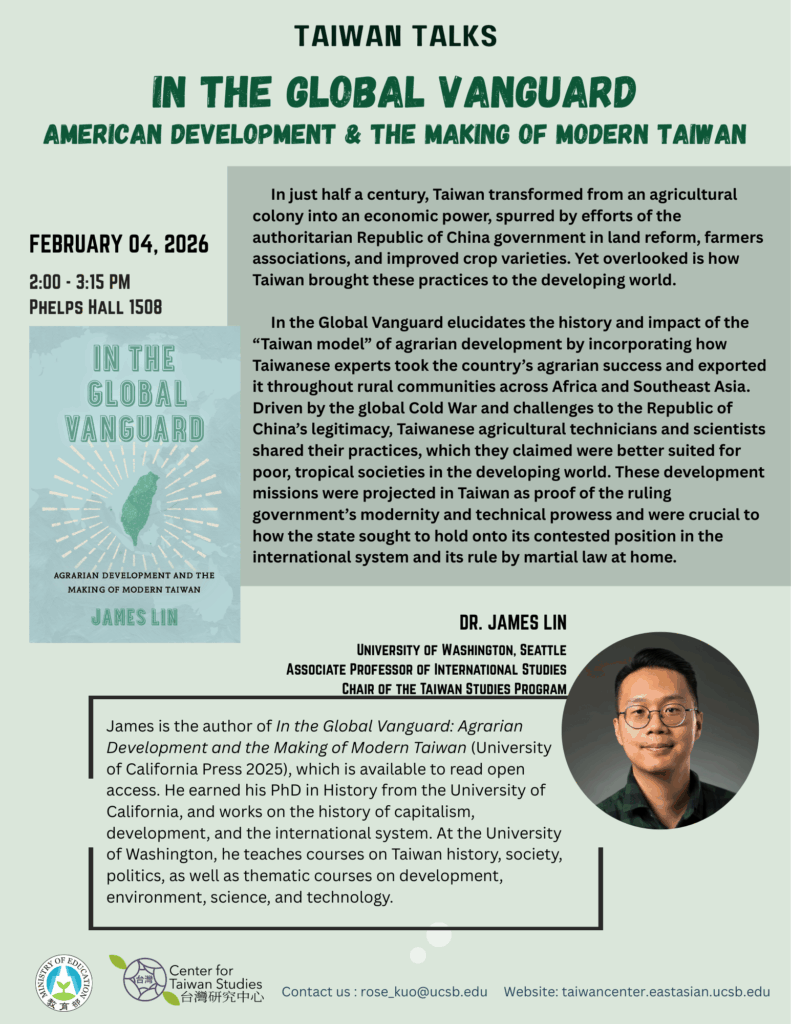
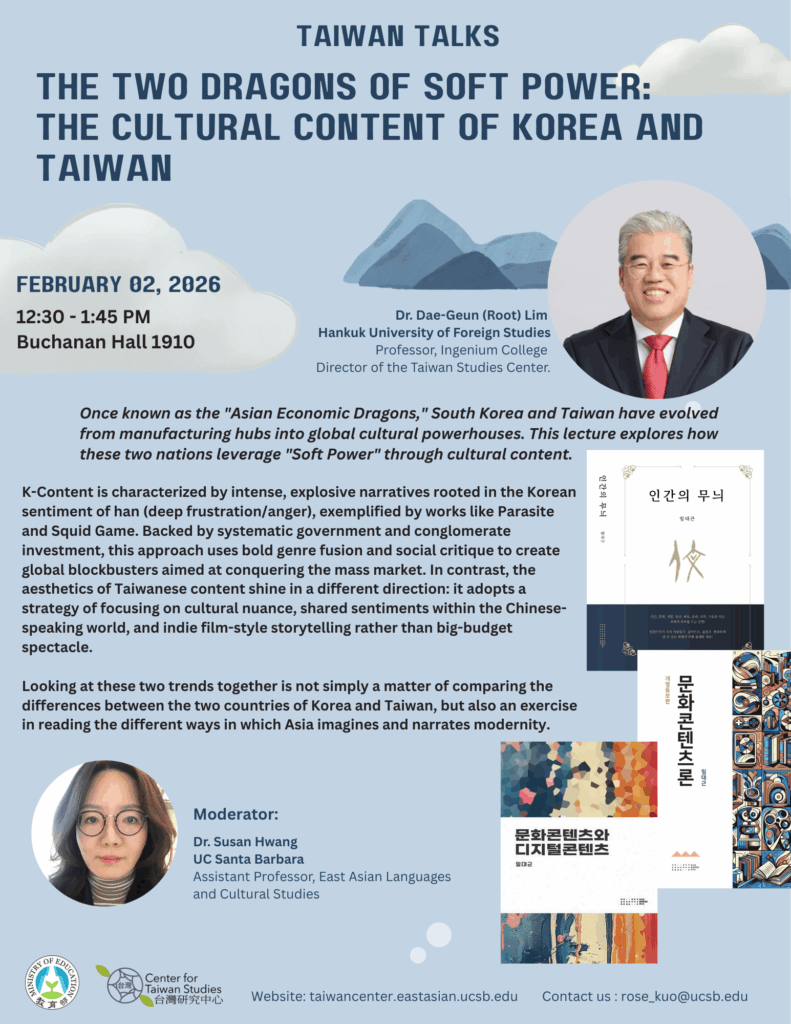
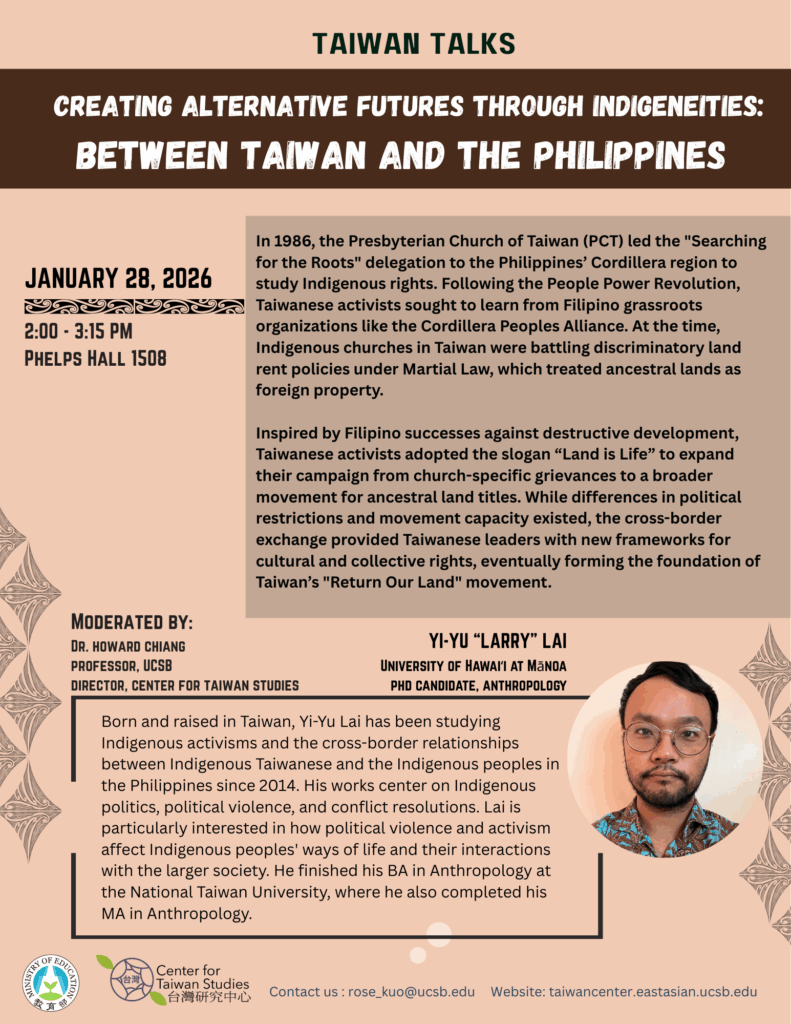
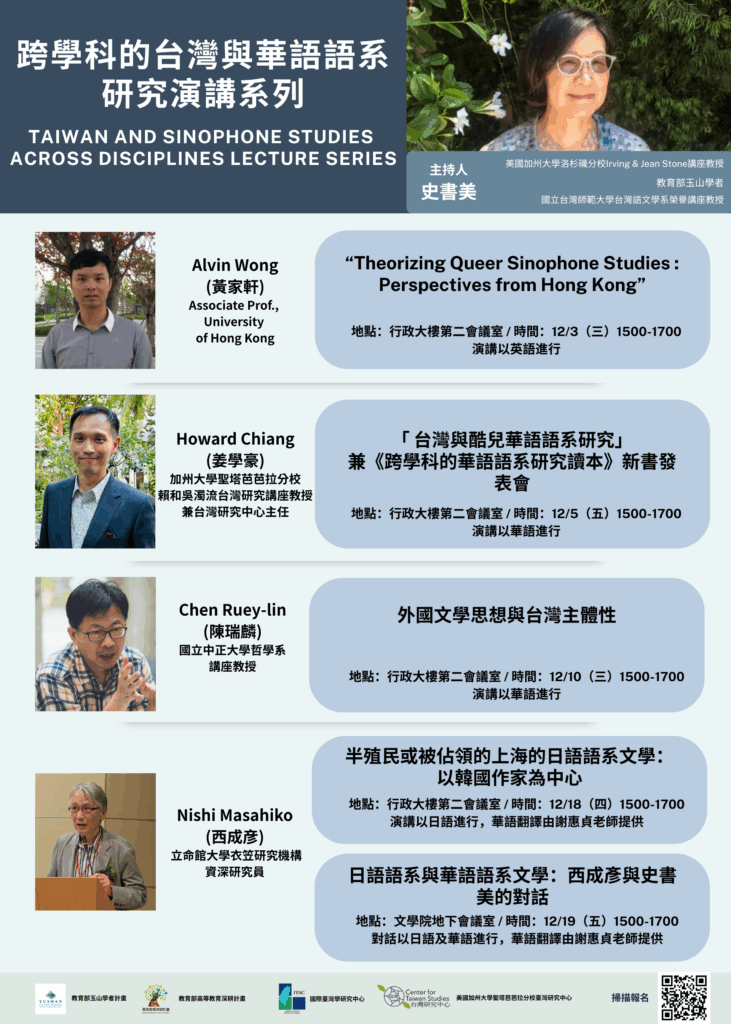


Chiang Kai-shek’s “Righteous Compatriots” in the Global Cold War: Displacement and Relief of Dachen Refugees in the First Taiwan Strait Crisis
Dominic Meng-Hsuan Yang (University of Missouri-Columbia)
May 29, 2024 Wednesday
12:30 pm-1:45 pm (PT)
Zoom Link:
https://ucsb.zoom.us/j/4177296373?pwd=dW9MWXNRYUtLc3pJS3ltZXo0VkhWUT09
Meeting ID: 417 729 6373
Passcode: 752786